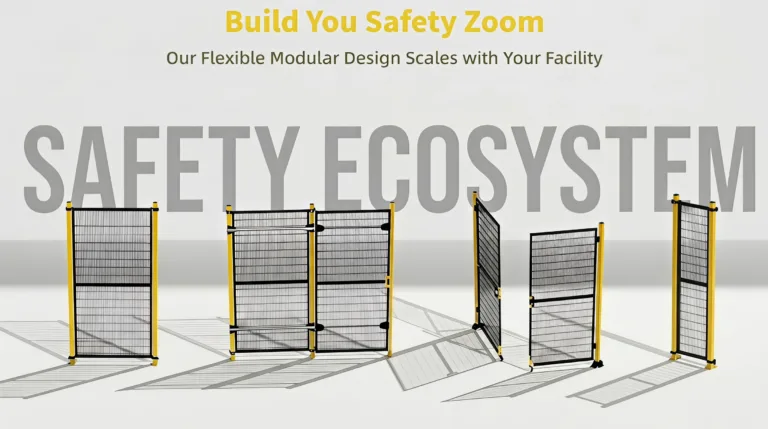

In industrial automation projects, machine guarding fences are not simply physical barriers.
They are part of a safety system designed to prevent human exposure to moving machinery and hazardous zones.
For most factories, machine builders, and system integrators, the first concern is not appearance or structure—it is compliance. Whether the system meets local and international safety standards often determines whether a project can be approved, installed, and operated.
Across global markets, three standards are most commonly referenced in machine guarding design: ISO 14120, OSHA requirements, and AS/NZS machinery safety standards. While they come from different regions, they all focus on the same goal: ensuring operators cannot access hazardous machine areas during operation.
ISO 14120 is the international standard that defines how machine guards and safety fencing systems should be designed and constructed.
In simple terms, it sets the baseline for whether a guarding system is considered safe for industrial use.
This standard focuses on several practical requirements. A machine guard must be strong enough to withstand industrial conditions, stable during long-term operation, and resistant to foreseeable misuse such as climbing or forced entry. It must also effectively prevent access to hazardous moving parts.
In real applications, this means that every detail of a machine guarding fence—from the frame structure to the mesh panel and fixing system—needs to be designed with safety performance in mind, not just appearance or cost.
At Brio, ISO 14120 is not treated as a reference document at the end of design. It is built into the structure of every system from the beginning.
In the United States, machine safety is regulated by OSHA.
Unlike design-focused standards, OSHA is based on a very direct principle: if a machine creates a hazard, that hazard must be physically isolated.
In practice, this means machines such as robotic arms, conveyors, stamping equipment, or automated production systems must be fully separated from operators during operation. Workers should not be able to enter dangerous zones while equipment is running.
This is why machine guarding fences used in OSHA-compliant environments are not just simple barriers. They are part of a complete safety system that often includes access doors, interlocks, and controlled entry points.
Brio systems are designed with this in mind, making them suitable for integration into automated production lines where safety and accessibility must work together.
One of the most common questions is whether to choose wire mesh panels or polycarbonate panels.
In Australia and New Zealand, machinery safety is governed by AS/NZS 4024.
These standards place strong emphasis on one key idea: even if a fence is installed, it must still be impossible for a person to reach the hazardous area.
This introduces an important concept in machine guarding design: safety distance.
Safety is not only about installing a fence. It is about the relationship between the fence, the machine, and human reach capability.
For example, smaller mesh openings reduce the ability to reach through the fence, while larger openings require greater installation distance from the hazard. In all cases, the goal is the same—ensuring the dangerous area is physically unreachable under normal and foreseeable conditions.
One of the most important but often overlooked aspects of machine guarding is safety distance.
A common misunderstanding is that once a fence is installed, the area is safe. In reality, safety depends on multiple factors working together.
These include mesh size, installation distance, human reach range, and whether tools could be used to extend access. If any of these factors are not properly considered, the system may fail to meet compliance requirements even if a fence is present.
This is why machine guarding design is not just about manufacturing panels—it is also about planning layout and positioning as part of the safety system.
At Brio, machine guarding is treated as an engineering system rather than a standalone product.
Our approach is based on combining structural design with real industrial requirements.
From an ISO 14120 perspective, our systems are built with reinforced modular frames and stable connection structures designed for long-term industrial use. Anti-climb mesh and rigid panel design are used to improve physical protection.
For OSHA-related applications, our systems are designed for full perimeter machine enclosure and can be integrated with safety interlocks and controlled access doors commonly used in automated production environments.
For AS/NZS-related requirements, we support different mesh configurations and assist in layout planning to help customers achieve proper safety distance in real factory conditions.
Beyond manufacturing, Brio also supports CAD layout design and system configuration, helping customers plan machine safety solutions before installation.
Machine guarding systems are not standalone industrial products. They are part of a safety framework governed by strict international standards.
Whether it is ISO 14120, OSHA requirements, or AS/NZS safety rules, the principle is consistent: hazardous machinery must be physically isolated in a way that prevents human access during operation.
For industrial buyers, selecting a machine guarding system is not only a procurement decision. It is a safety decision that directly affects compliance, operation approval, and long-term factory safety performance.
At Brio, this understanding is the foundation of every system we design and manufacture.